Hope
The Knife of Never Letting GoHope is presented as a contested belief rather than a guarantee: Ben urges Todd and Viola to trust that a future remains possible, while Viola later admits she does not expect a hopeful ending and keeps going anyway. Its importance lies in that distinction. Hope offers no proof that Haven will be reached or that suffering will stop; it gives the two travelers a way to continue when fear, loss, and uncertainty might otherwise halt them.
Ben’s Case for Hope
When Ben tells Todd and Viola that there is always hope, the claim initially sounds almost incomprehensible to them. Todd says there is little hope in the world they have crossed; Viola names fear, and Todd answers with despair. Their response establishes hope not as a shared assumption but as an idea that their experience has made difficult to accept.
Ben answers by pointing to what they have already survived. They have crossed farther than most people on the planet, overcome obstacles and dangers, outrun an army and a madman, and endured deadly illness. He turns their journey into evidence: their survival, he argues, is itself a reason to believe that hope exists. The argument does not erase the danger they faced. Instead, it reads their endurance as something more than chance or mere continuation.
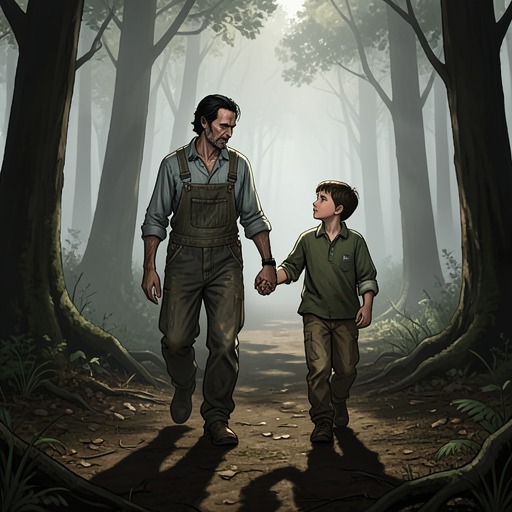
His certainty has an important limit. Ben does not claim to know what waits for the travelers at the end of the road. He says that he believes there is hope for them, and that the belief is precisely what makes it hope. When he squeezes Todd’s arm as he says the word, the abstract claim becomes a personal assurance offered directly to both of them. Hope here is not foreknowledge; it is an act of trust made in the absence of foreknowledge.
Loss and the Choice to Continue
Later, Viola names the losses that shape her understanding of the road ahead: Ben, Manchee, and her mother and father are gone, and she hates that fact. Her statement does not soften grief or replace it with optimism. Instead, she places the losses beside the knowledge that the travelers are almost at the end of the road. For her, approaching a destination and mourning those who are absent coexist; one does not cancel the other.
Todd asks whether she believes there is hope at the end. Viola answers no, but immediately distinguishes disbelief from surrender: she is still going, and asks whether he is coming with her. Todd does not need to answer aloud. They carry on running. The exchange recasts Ben’s earlier appeal. Viola does not adopt his belief as a certainty; she makes forward movement possible without it. Her invitation also makes persistence shared rather than solitary: Todd’s next step is bound to hers, even when neither can establish what the road will deliver.
Hope as Forward Motion
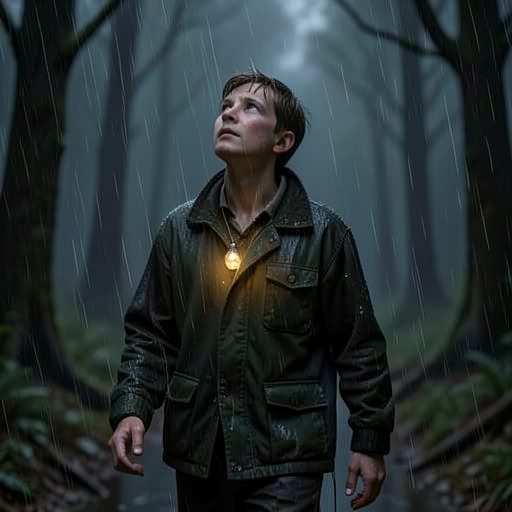
Running becomes the concrete form hope takes. Todd and Viola continue together, and the possibility of hope surfaces in Todd’s thoughts as something he is reluctant to let himself believe. That hesitation matters: the possibility is neither secure nor comfortable. It flickers alongside his effort not to think it, showing how hope can attract and unsettle him at the same time.
Todd understands hope as a force that may pull people forward and keep them going, but also as dangerous, painful, and risky. To hope is to dare the world to answer favorably, despite the travelers’ history of hardship. The thought does not resolve that risk; it makes the act of continuing an exposure to possible disappointment. Hope therefore has practical force without becoming a prediction: it can sustain motion while leaving the outcome unknown.
Haven and the Uncertain End of the Road
As the travelers run, Viola looks back at Todd, urges him on with tilts of her head, and smiles. Todd pleads inwardly for Haven to be there. The destination gives their hope a particular direction, but his plea makes clear that reaching it is still uncertain. The landscape changes as they approach: the road rises above the river, the water crashes through rocky rapids, the wooded stretches disappear, and the valley closes toward the river and the falls. These details bring the journey to a threshold without confirming what awaits beyond it.
The scenes leave hope deliberately unresolved. Ben can believe on the travelers’ behalf; Viola can proceed without believing; and Todd can want Haven to be there while fearing the risk of wanting it. Their different positions do not prevent them from continuing together. Hope’s significance lies in that continuing movement—not in proof of a happy outcome, but in the possibility that a future remains worth approaching.